11 Bakheng Street, Svay Dangkum,
Siem Reap, Cambodia
Email our experts:
info@truenorthlean.com
11 Bakheng Street, Svay Dangkum,
Siem Reap, Cambodia
Email our experts:
info@truenorthlean.com

Blog

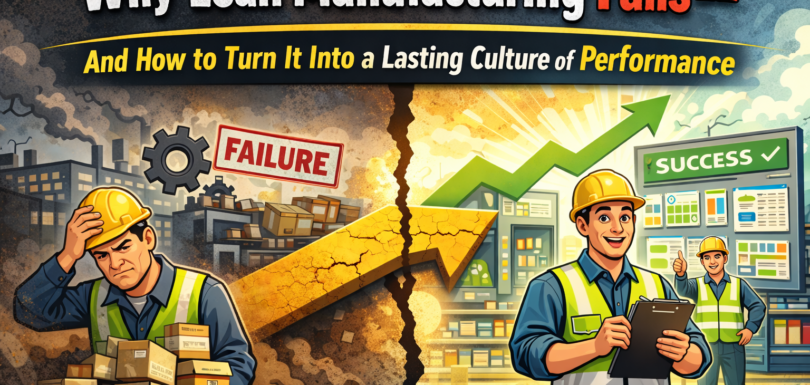
Why Lean Manufacturing Fails And How to Turn It Into a Lasting Culture of Performance

Lean manufacturing is often described as a set of tools. 5S. Kanban. Just-in-Time. Value Stream Mapping. Yet in reality, Lean is less about tools and more about behaviour. When implementation fails, it is rarely because the tools are wrong. It is usually because the mindset is missing. Across industries, from automotive to pharmaceuticals, the same pattern repeats. Leadership announces a Lean initiative. Posters go up. Training sessions are conducted. A few workshops are completed. Then, quietly, things drift back to “the way we’ve always done it.” Employees begin calling it the “flavor of the month.” Resistance grows. Momentum fades. The root of the problem is cultural resistance. In many traditional manufacturing environments, routines have been built over decades. Operators have developed their own workarounds. Supervisors manage based on experience rather than data. When Lean enters the system, it challenges habits. Standardization feels restrictive. Visual boards feel like surveillance. Continuous improvement feels like extra work. Without careful communication, people assume Lean means job cuts or unrealistic targets. When fear replaces understanding, even the best-designed Lean program struggles to survive. Another common mistake is treating Lean as a short-term project rather than a long-term philosophy. Organizations often rush to implement advanced tools like Just-in-Time without stabilizing basic processes. JIT, for example, requires reliable equipment, disciplined maintenance, and consistent quality. If machines break down frequently or tools are poorly managed, reducing inventory simply exposes chaos. What appears to be a Lean failure is actually a foundation failure. There is also the issue of inadequate training. Teaching people how to fill out a Kanban card is not the same as teaching them how to think scientifically. Lean requires problem-solving capability at every level. Without building this capability, companies copy techniques without understanding why they work. Infrastructure challenges further complicate implementation. Poorly aligned production lines create bottlenecks. Departments operate in silos. Excess inventory hides inefficiencies. When processes are disconnected, Lean tools become cosmetic rather than transformative. Case Study: Rebuilding Lean from the Ground Up Consider a mid-sized automotive components manufacturer in Western India. The company had attempted Lean twice in five years. The first effort focused on implementing Just-in-Time deliveries to reduce warehouse costs. Inventory was cut aggressively. Within months, production disruptions increased. Tool failures caused delays. Emergency purchases became frequent. Customer complaints rose. Management concluded that Lean “does not suit our environment.” Two years later, under new leadership, the company took a different approach. Instead of starting with inventory reduction, they began with 5S in one pilot area. Teams were trained not only on how to organize their workspace, but on why disorder created waste. Simple actions such as labeling tools, defining storage locations, and cleaning machines daily revealed underlying problems. Oil leaks were identified. Worn fixtures were replaced. Minor stoppages were tracked visibly. Next, they mapped process flow using spaghetti diagrams. Movement of materials and operators was analyzed. Layout adjustments reduced unnecessary travel. Maintenance routines were standardized. Only after equipment reliability improved did they gradually reintroduce Just-in-Time principles. This time, the results were different. Over eighteen months, work-in-progress inventory reduced by 28 percent. On-time delivery improved from 82 percent to 96 percent. More importantly, employee engagement scores rose significantly. Operators began suggesting improvements voluntarily. Lean was no longer a management program. It became a shared language. The difference was not the tools. It was the sequence, patience, and cultural focus. Sustainable Lean implementation demands top-down commitment combined with bottom-up participation. Leaders must model problem-solving behaviour rather than demand quick results. Supervisors must coach instead of command. Employees must feel safe to identify waste and highlight bottlenecks. Lean thrives when organizations shift from asking, “Which tool should we implement next?” to asking, “What problem are we trying to solve?” That subtle shift changes everything. When companies build a culture that values transparency, learning, and steady improvement, Lean stops being a project. It becomes the way work is done. And once that cultural foundation is in place, the tools finally begin to deliver their full potential.
Continue Reading

Getting a Production Plant Back on Its Feet

When the company shifted operations to a new facility, the mood was optimistic. The building was modern. The layout looked promising. The machines were better than before. On paper, everything suggested performance would improve. Reality was different. Production hovered around 55 percent of expected capacity. Orders were delayed. Supervisors were constantly juggling priorities. Operators were working hard, yet results did not reflect the effort. Something was clearly off, but no one could point to a single obvious cause. So instead of reacting with quick fixes, the leadership team chose to slow down and really look at what was happening. For several weeks, the focus was simple: observe, listen, and understand. Time was spent on the shop floor watching how work flowed from one station to another. Conversations were held with operators, maintenance teams, planners, and supervisors. Equipment usage was reviewed in detail. Not from reports alone, but in real time. One supervisor said it honestly: “We are busy all day, but it doesn’t feel smooth.” That sentence captured the problem perfectly. As the review progressed, a few patterns became clear. One production area was overloaded almost every shift. Work piled up there, creating pressure and delays downstream. Meanwhile, other departments had capacity they could not fully use. The imbalance was slowing the entire system. Technology told a similar story. Some advanced machines were being used for relatively simple tasks, while automated systems capable of much higher output were not consistently scheduled. It was not a competence issue. It was a coordination issue. Processes had also become more complicated than necessary. Extra steps had been added over time. Workarounds had become normal practice. Handoffs were not always clearly defined. None of these were dramatic problems on their own, but together they created friction throughout the plant. Material losses were higher than expected. When traced carefully, they were linked to unclear sequencing and inconsistent handling. Small inefficiencies, repeated daily, were quietly costing the company significant money. The improvement effort did not rely on dramatic restructuring. It focused on fundamentals. Workloads were rebalanced so that no single area carried disproportionate pressure. Tasks were better aligned with equipment capability. Process steps were simplified where possible. Clearer standards were introduced so that everyone understood how work should flow. Importantly, changes were tested with the people doing the work. Their feedback shaped the adjustments. When employees saw that practical suggestions were taken seriously, engagement improved noticeably. Within months, stability began to return. Daily output became more predictable. Firefighting reduced. Material waste dropped, resulting in annual savings of approximately USD 385,000. More than thirty quality and safety issues were identified and resolved. Equipment utilization improved without requiring new capital investment. Perhaps the most meaningful change was cultural. Conversations shifted from blame to problem solving. Teams felt more in control. Managers reported spending less time reacting and more time planning. Looking back, one executive reflected, “The move did not break us. It exposed what we had not fully understood.” The lesson is straightforward. New facilities and modern machines do not guarantee performance. Clear processes, balanced workloads, and disciplined coordination do. When those fundamentals are restored, results follow.
Continue Reading

Why Sustainability Training Is Becoming Part of Everyday Business

When you sit with business leaders these days, there is a certain mix of curiosity and concern in the room. Everyone can feel that the world around them is shifting. Weather patterns affect supply chains. Energy bills behave unpredictably. Customers want clarity on where products come from and how responsibly companies operate. None of this feels abstract anymore. It shows up quietly in operational costs, planning cycles and even recruitment conversations. This is why more organisations are asking their teams to learn about sustainability in a practical, business focused way. Not as a theory, not as a compliance requirement, but as a skill set they genuinely need. At True North Lean, we see this every week. Teams who once spoke only about efficiency or cost now have questions about carbon footprints, waste streams and long-term resilience. It is a natural evolution in how companies think about their future. To support this, we offer training that helps people make sense of what sustainability actually means in a business environment. Many participants walk in feeling unsure where to begin, and they leave with a clearer view of the landscape. The sessions break down global issues into everyday realities. How resources are used, how waste travels through a system, how people in an organisation make choices without realising the ripple effect those choices create. It is eye opening for many because the concepts are not presented as pressure. They are shown as opportunities to strengthen operations. The learning style is interactive and conversational. People exchange stories from their own workplaces, point out odd habits they never questioned and begin connecting dots. Once they understand the basic pillars of sustainability, it becomes easier to see where their organisation stands and where improvements genuinely make sense. We encourage them to think small at first. A few thoughtful changes in processes often make a noticeable difference. Alongside this foundational training, we also offer another pathway for teams already immersed in Lean. This group tends to pick up sustainability ideas very quickly because Lean thinking already trains the eye to see what others miss. When they look at sustainability through that lens, things start clicking. Waste takes on a broader meaning, covering everything from excess electricity to unnecessary transport or poorly designed workflows that silently drain resources. The beauty of this approach is its practicality. Lean practitioners already know tools like root cause analysis, visual management or value stream mapping. During our training, they learn to adapt these tools to reveal environmental impact alongside operational performance. For example, a simple walk through a facility may uncover machines running longer than needed or materials being handled in ways that raise costs and environmental load simultaneously. These discoveries come from observation, not theory. Culture plays a huge role as well. Sustainability cannot grow if it sits in one department. It becomes part of the company’s rhythm only when everyday conversations begin to shift. Our training emphasises this. Teams learn how to bring sustainability into routine discussions, improvement meetings and decision making processes without making it feel heavy or complicated. Once people start noticing small patterns, they naturally suggest improvements. That is how real change begins. Why is all of this so important now? Because businesses are realising that sustainability is not a trend. It is part of long term risk management, brand trust and operational strength. Markets are changing faster than before, and companies with stronger internal capability will always adapt better. Training gives people the language, the confidence and the perspective they need to participate in that transition. At True North Lean, our role is simple. We help organisations build teams that can think clearly, work responsibly and look ahead rather than react late. Sustainability and Lean complement one another more than most people expect. Both are about noticing what others overlook and creating systems that work well over time. Companies that invest in this learning today are positioning themselves for a more resilient tomorrow. They gain employees who understand the bigger picture, leaders who can guide meaningful change and operations that run with greater awareness. In a world where expectations grow every year, that mindset makes all the difference.
Continue Reading

Rebuilding Strength A Quiet Story of Lean and the People Who Lived It

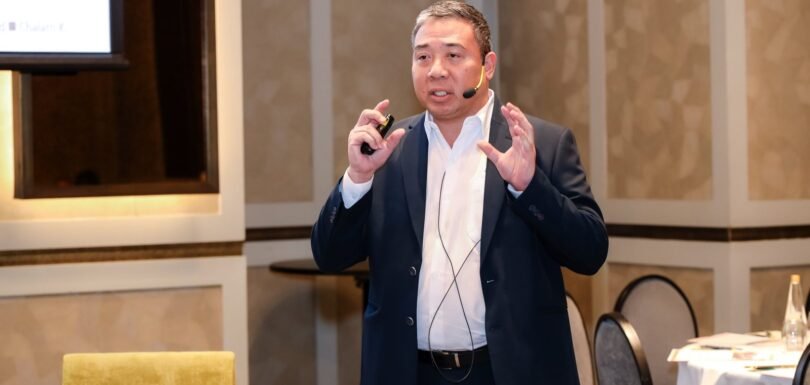
Presented at the True North Lean CXO Summit in Vietnam There are stories that come dressed in numbers and charts. Then there are stories that arrive quietly and stay with people long after the session ends. When Chalath Kongsuwan spoke in Vietnam during the True North Lean CXO Summit, his story felt like that. It did not try to impress anyone with complicated jargon. It felt more like a leader looking back on something his team went through together, a moment that changed the way they understood their work and one another. Chalath leads a large aerospace component facility in Thailand, a place where precision is not optional and delays affect aircraft manufacturers around the world. His experience runs deep, but even years in this industry do not prepare anyone for the shock of a sudden fire. It happened in 2023. One moment the plant was full of movement and rhythm, and the next the entire atmosphere changed. The kind of stillness that follows an unexpected event is something people remember for a long time. The Turning Point After the fire, many expected long downtime. Yet what happened next surprised even those inside the organisation. The team did not sink into uncertainty. They moved. Slowly at first, almost cautiously, and then with more confidence. What could have been a long recovery became one of the quickest the company had ever seen. Chalath described that period with a kind of calm appreciation. He remembered the faces of his team members, how they gathered without being asked, how small groups formed on their own to inspect areas, plan tasks or simply reassure each other. Lean was not a theory in that moment. It was a behaviour that rose naturally. The People Behind the Structure In the months that followed, the organisation created groups to guide the transformation. A committee helped keep the direction steady, but the real spark came from the people inside those groups. They were not chosen for their titles as much as for their willingness to step forward. Some focused on standard work, others on technical issues, others on communication. What mattered was that they supported each other. Something shifted. Teams that usually worked in separate sections began showing up in one another’s areas, asking questions, suggesting ideas and learning small details they never paid attention to before. It felt less like a formal structure and more like a community taking shape. Looking Closely at the Work Before improvement began, everyone spent time looking closely at the entire flow of work. People walked through the plant with a different kind of attention. They stood longer near machines. They watched how materials moved, how waiting built up silently, and how small obstacles grew into bigger delays. What they saw changed the way they felt about improvement. It was no longer something introduced from outside. It became something they wanted to fix because they saw how much potential was being lost. For many employees, this was the first time they truly saw their workplace from edge to edge, not just the area they were responsible for. Small Wins That Built Confidence Once they started improving, progress came from many directions. Some teams found ways to make cutting output smoother. Others worked on machine effectiveness in forging. Quality teams looked at how to reduce rework. Set up teams focused on reducing changeover time. Etching and finishing teams looked for places where small delays added up. None of these improvements looked dramatic on their own. But together they created a rhythm of progress. The atmosphere changed. People who had never spoken much started offering suggestions. Younger staff stepped up. Supervisors stopped sounding like supervisors and more like guides. That was when the transformation really rooted itself. Daily Habits That Held Everything Together What truly moved the culture forward were the habits that formed. The plant started its mornings by gathering around simple boards that showed what was happening that day. Conversations were short and honest. People pointed out what went well, what looked worrying, and what needed someone’s attention. Leaders walked the floor not to check compliance but to understand the work. They asked questions, listened and helped remove obstacles that slowed people down. A cleaning day also took place. It was not just about sweeping or rearranging shelves. It was a moment when everyone stopped thinking of the plant as separate sections and began to see it as one shared space. That day mattered more than many realised. It connected people in a quiet, genuine way. A Thought That Stayed With Every Listener At the summit in Vietnam, one sentence from Chalath stayed with the audience. He said that tools may improve a process, but only a shift in mindset changes an organisation. There was a stillness in the room when he said it. It sounded simple, almost too simple, but it felt true. After all, the story he told was not about perfect implementation. It was about people who decided to move forward even when the situation felt heavy. His message reminded everyone that Lean begins with people who care enough to look honestly at their work and at themselves. A Workplace Renewed by Its Own People Today the plant in Thailand stands stronger than before the fire. The recovery built a deeper kind of unity. People who once saw their roles as separate now see themselves as part of one shared effort. Communication flows easier. Collaboration feels natural. New ideas do not need encouragement to appear. They come on their own. The transformation is not a finished chapter. It continues, evolving with each conversation and each new problem that emerges. And that is perhaps the most powerful sign of all. A Lean journey is never complete. It grows as the people grow. A Story With Lessons Beyond One Plant Many leaders left the summit remembering not the technical details but the emotional truth of Chalath’s account. It showed that resilience grows fastest when people trust each other. It showed
Continue Reading

Know Your Lean Guru: Genichi Taguchi’s Quiet Revolution in Quality Thinking

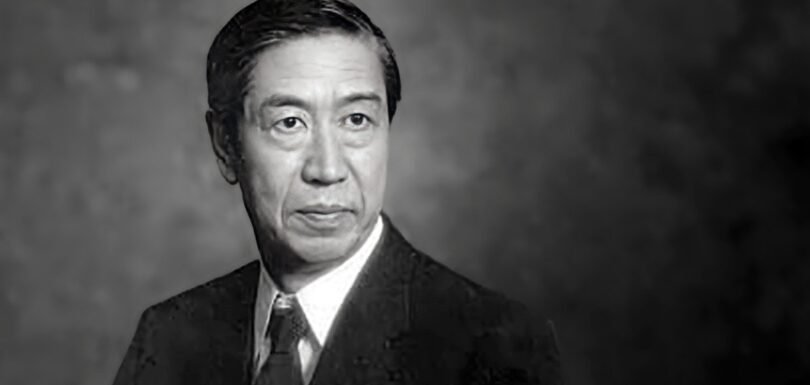
Every once in a generation, someone steps into an industry and quietly rewrites the rules. Genichi Taguchi did exactly that. He was not a loud reformer, nor did he chase spotlight or status. Yet the ripple of his ideas still shapes how companies design products, develop systems and think about variation. In many ways, the modern emphasis on building quality into the earliest stages of design traces straight back to him. Taguchi’s life began far away from the factories and laboratories where he would later leave his mark. Born in Tokamachi, a textile town known for its kimono heritage, he grew up surrounded by craftsmanship and precision. His first ambition was to join the family business. But the turbulence of the 1940s pushed him in another direction when he was assigned to the Astronomical Department of the Imperial Japanese Navy. This unexpected detour exposed him to measurement, data and the discipline of scientific thinking. When the war ended, Japan was rebuilding almost everything—from infrastructure to industry. Taguchi found himself working at the Ministry of Public Health and Welfare, where he met one of the most important influences of his life, statistician Matosaburo Masuyama. Their conversations opened Taguchi’s eyes to the potential of designing experiments rather than relying on trial and error. His later work at the Institute of Statistical Mathematics and his involvement in improving penicillin production gave him practical experience in applying statistical ideas to real problems. Everything accelerated in the early 1950s when he joined the Electrical Communications Laboratory of Nippon Telegraph and Telephone. Japan at that time was hungry for industrial revival, and Taguchi found himself in an environment where every improvement mattered. Influenced by the teachings of W. Edwards Deming and surrounded by engineers trying to match Western innovation, Taguchi began refining the ideas that would later carry his name across the world. It was here that he realised something simple but profound: real quality is created long before a product reaches the assembly line. His international collaborations strengthened these ideas even further. During his fellowship at the Indian Statistical Institute, he worked closely with C. R. Rao and learned about orthogonal arrays, a concept that allowed engineers to run sophisticated experiments without drowning in complexity. His later interactions with John Tukey at Princeton and the eventual acceptance of his methods at Bell Labs turned what was once considered unconventional into a global practice. Companies like Ford, Xerox, Boeing and ITT became strong adopters once they discovered the cost savings and performance improvements Taguchi’s system could deliver. His Contributions That Changed the World of Industrial Quality Taguchi’s work often appears technical when explained formally, but the heart of it is surprisingly intuitive. A few of his major ideas include: The Taguchi Loss FunctionInstead of thinking that a product is fine as long as it sits “within tolerance,” Taguchi argued that any movement away from the ideal target creates a loss to society. Quality is not a pass-or-fail event; it has a cost curve. Off-line Quality ControlHe pushed industries to focus on the design stage rather than relying on inspection at the factory floor. When a product is designed correctly, everything downstream becomes smoother. Innovations in the Design of ExperimentsHis use of orthogonal arrays made experimentation faster, efficient and accessible to engineers who were not statisticians. He also introduced the idea of using an outer array to represent uncontrollable real-world factors, allowing engineers to test robustness before the product ever existed. These ideas helped organisations reduce variation, simplify decision-making and build products that performed consistently despite unpredictable environments. Recognitions and Honours Across the World Taguchi never worked for fame, yet recognition followed him throughout his career. His honours paint a clear picture of his global influence: • Deming Prize for Individuals (1960)• Willard F. Rockwell Medal of the International Technology Institute (1986)• Indigo Ribbon from the Emperor of Japan (1989)• Recognised as a “Quality Guru” by the British Department of Trade and Industry (1990)• Honorary member of the Japanese Society of Quality Control (1995)• Honorary Fellow of the Institute of Directors, India (1996)• Automotive Hall of Fame Inductee (1997)• Honorary member of the American Society for Quality and the American Society of Mechanical Engineers (1998)• Honorary President of the Robust Quality Engineering Society of Japan (1999) Each honour represents a different industry, yet all of them point toward one truth: Taguchi’s thinking broke through borders and languages because it solved universal problems. Books That Carried His Ideas Into New Generations Taguchi wrote and co-authored several influential works that helped thousands of engineers and quality leaders understand his methods more deeply. A few of his well-known titles include: Introduction to Quality Engineering (1986)Taguchi on Robust Technology Development (1992)Robust Engineering (1999)The Mahalanobis-Taguchi System (2000)The Mahalanobis-Taguchi Strategy (2002)Computer-Based Robust Engineering (2004)Taguchi’s Quality Engineering Handbook (2005) These books did not just teach techniques. They encouraged a mindset—one that challenges noise, variation and inconsistency by approaching design with calm, structured thinking. A Legacy That Still Shapes How We Build and Improve Genichi Taguchi’s influence continues to live inside every modern quality system, even when people using those systems may never have heard his name. His legacy is not simply statistical tables or formulas. It is an idea:Quality is created with intention, not by chance. And that single belief has helped industries save billions, improve reliability, protect consumers and shape the philosophy that Lean practitioners apply every day. Taguchi remains one of the most important pioneers of quality engineering, a quiet mind who changed how the world thinks about designing for excellence.
Continue Reading

Building a Culture of Sustainable Excellence: Insights from Dave Becnel at the True North Lean CXO Summit, Ho Chi Minh City

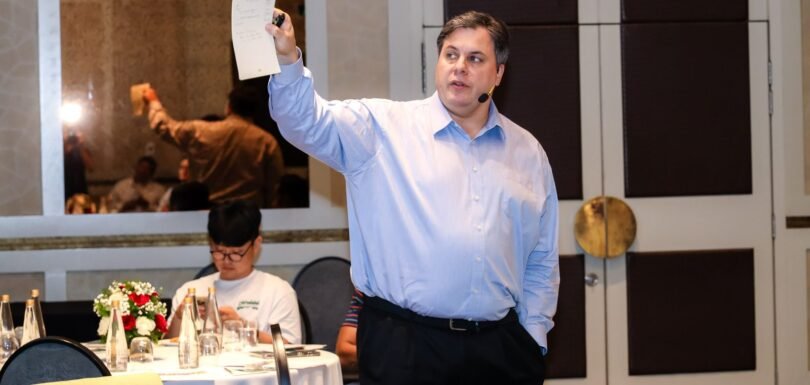
There are speakers who share concepts, and then there are speakers who share clarity. When Dave Becnel, VP Quality Vietnam at Techtronic Industries TTi, addressed the audience at the True North Lean CXO Summit in Ho Chi Minh City, he offered something far more valuable than theory. He shared a grounded perspective on how sustainable excellence is truly built inside an organisation. His message was simple but powerful. Lasting performance comes from people who are capable, confident, and trusted to take ownership of their work. Dave’s long journey through engineering, production, Lean promotion, manufacturing, and quality leadership has given him a deep understanding of what makes operations thrive. His experience is not academic. It comes from years of supporting teams, fixing processes, and building systems that continue working even when no one is watching. Self Reliance The Heart of Sustainability Dave began by highlighting one of the most overlooked truths in manufacturing. Production teams must be able to manage their own lines. In many factories, support departments become crutches. Lean teams, quality controllers, and engineers often step in to solve issues that the frontline should be capable of handling. This does not empower people. It weakens the culture. True sustainability starts when production teams understand their process and can control quality, safety, cost, delivery, and improvement on their own. This mindset builds responsibility. It builds pride. And over time, it builds a culture where problems are solved at the source instead of being passed from one department to another. Highly Capable Lines The Foundation of Operational Excellence Dave emphasised that sustainable excellence depends on building highly capable production lines. These are lines where flow makes sense, ergonomics protect workers, equipment is reliable, and quality is designed to be right the first time. When these elements come together, the line becomes stable. Operators feel in control. Leaders stop firefighting and begin focusing on real improvement. But achieving this capability rarely happens if improvement begins only after mass production starts. Many organisations wait for problems to appear before looking for solutions. By then, waste is expensive and change becomes disruptive. 3P A Better Way to Build Excellence Dave introduced a concept that many organisations underestimate. The Production Preparation Process or 3P. Instead of separating design, industrialisation, and mass production into different phases, 3P brings everyone together early. Designers, engineers, pilot teams, and frontline operators sit together, explore options, and shape the process before it becomes permanent. This early collaboration eliminates waste before it ever reaches the production floor. It helps teams design processes that are safer, simpler, more ergonomic, and more cost effective. It also helps operators feel deeply connected to the process because they helped create it. Dave shared that real margin growth happens here, not after the line is already running. When waste is prevented instead of corrected, operational excellence becomes much easier to sustain. Leadership Sets the Tone At one point in his session, Dave pointed out something that every senior leader should reflect on. Frontline sustainability mirrors the discipline of the boardroom. If leaders do not prioritise stability, clarity, and support, the frontline will struggle to maintain improvement. But when leaders consistently model the behaviours they expect, the entire organisation follows that example. A culture of excellence needs strong expectations from the top and strong empowerment at the bottom. When those two forces meet, sustainability becomes natural. Problem Solving Keep It Simple Keep It Together One of the most human parts of Dave’s presentation was his reminder that problem solving does not need to be complicated. Fancy tools and complex methodologies are not the answer. What matters most is getting the right people in the same room and working through the issue with discipline and honesty. Simple formats like 4C or RCCA are often enough to solve even serious problems when they are used correctly. The key is clarity. Teams must understand the real problem. They must understand the real root cause. And they must agree on how to prevent it from returning. When organisations commit to this kind of simple, shared thinking, improvement becomes much faster and far more consistent. Three Lessons That Stay With You Dave wrapped up his presentation with three lessons that apply to any organisation striving for lasting excellence. Empower people first Self reliant teams build ownership and pride. When people feel capable, sustainability follows naturally. Build production friendly designs Cross functional collaboration during preparation and design prevents waste, improves quality, and creates margins before production begins. Use simple problem solving Strong teamwork and simple tools used with discipline can solve most issues faster than complex methods used without understanding. A Message That Will Influence Leaders For Years The True North Lean CXO Summit brought together leaders from across Asia who are shaping the next chapter of operational excellence. Dave Becnel’s message stood out because it was real. It was practical. And it reminded everyone that improvement begins and ends with people. In today’s world of technology and automation, his presentation was a timely reminder. Sustainable excellence does not come from tools. It comes from cultures built on trust, clarity, and shared ownership. When people are empowered to control their work and leaders support them with discipline and consistency, organisations do more than improve. They transform.
Continue Reading

Categories

  • No categories

Latest Posts

Subscribe Newsletter

Sign up to receive notifications about the latest news and events from us!

    x

    Inspiring Your Team to Continuous Growth and Sustainable Excellence.

    Address Business
    11 Bakheng Street, Svay Dangkum,
    Siem Reap, Cambodia
    Contact With Us
    +855 10 983138
    info@truenorthlean.com
    Select the fields to be shown. Others will be hidden. Drag and drop to rearrange the order.
    • Image
    • SKU
    • Rating
    • Price
    • Stock
    • Availability
    • Add to cart
    • Description
    • Content
    • Weight
    • Dimensions
    • Additional information
    Click outside to hide the comparison bar
    Compare