11 Bakheng Street, Svay Dangkum,
Siem Reap, Cambodia
Email our experts:
info@truenorthlean.com
11 Bakheng Street, Svay Dangkum,
Siem Reap, Cambodia
Email our experts:
info@truenorthlean.com

Surya Narayan

  • Home
  • Author: Surya Narayan
  • Page 2

The Fishbone That Changed Everything

A human story behind the Ishikawa diagram Have you ever sat in a meeting where something went wrong and everyone started pointing fingers? The machine broke, the supplier was late, the new guy made a mistake, and suddenly no one agrees on anything. An hour later, you still have no real answer. Just a room full of frustrated people and a problem that still needs fixing. That feeling, that messy, circular blame game is exactly what Kaoru Ishikawa was trying to kill when he sat down and drew what the world would later call the fishbone diagram. Japan, 1943. A Country Trying to Rebuild. To understand why this diagram matters so much, you have to picture Japan in the early 1940s. The country’s factories were under tremendous pressure. Quality was inconsistent. Products were failing. And nobody really had a clear, structured way of figuring out why things kept going wrong. Kaoru Ishikawa was a chemical engineer working with a team at Kawasaki Steel Works. He noticed that whenever a defect showed up, people would chase symptoms instead of causes. They’d fix one thing, and the problem would come back through a different door. It was exhausting and wasteful. So in 1943, he did something simple but brilliant. He drew a diagram, a spine with branches coming off it, where every possible cause of a problem could be written down and grouped by category. It looked like the skeleton of a fish. And it worked. For the first time, teams could look at a problem together, from the same angle, without the conversation going in circles. The Man Who Believed Workers Had the Answers Dr. Kaoru Ishikawa was born in 1915 in Tokyo and spent most of his career at the University of Tokyo. He was deeply influenced by the quality movement happening around him, especially the ideas coming from American statistician W. Edwards Deming, but he took things in his own direction. What made Ishikawa different was that he genuinely believed ordinary workers, not just managers or engineers, could solve the problems around them if they were given the right tools and the right environment. He wasn’t interested in top-down quality control. He wanted it to be everyone’s job. He published the diagram formally in his 1968 book, Guide to Quality Control, and from there it spread first through Japanese industry, then to the rest of the world. He passed away in 1989, but the fishbone diagram he drew in a steel factory in 1943 is still being used in hospitals, tech companies, and classrooms every single day. So How Does It Actually Work? You start by writing the problem, the effect, on the right side of a page, like the head of a fish. Then you draw a horizontal line running left from it. That is your spine. Off that spine, you draw diagonal branches. Each branch represents a category of possible causes. In manufacturing, people often use the 6Ms: Man, Machine, Method, Material, Measurement, and Environment. In services or healthcare, the categories might look a little different, but the idea is the same: you are grouping causes so nothing gets missed and nothing gets confused with something else. From each of those branches, you keep asking “why?” and adding smaller branches for more specific causes. By the time you’re done, you have a complete pictur, not just one opinion, but every possible angle laid out in front of the whole team. A Real Example: Why Is the Coffee Always Wrong? Say you run a small café and customers keep sending back their coffee. The problem seems obvious, the coffee tastes bad. But is it really that simple? You sit down and draw the fishbone. Under People, you notice your barista was trained differently from the rest of the team. Under Machine, you discover the coffee grinder hasn’t been cleaned in two weeks. Under Method, there is no standard recipe, everyone is guessing the measurements. Under Materials, you find out the supplier quietly switched to a different bean last month without telling anyone. Suddenly, “the coffee tastes bad” becomes four separate, fixable problems. You retrain the team, clean the grinder, write down a standard recipe, and call the supplier. Within a week, the complaints stop. That is what the Ishikawa diagram does. It does not give you answers; it gives you the right questions. And sometimes, that is all you need. Still Relevant, All These Years Later There is something refreshing about a tool that has survived eight decades without needing an update. The Ishikawa diagram is still one of the seven basic tools of quality control recognised by ISO, and it is taught in business schools, engineering programmes, and healthcare training around the world. In a world obsessed with speed and technology, it is a quiet but powerful reminder that the best way to fix a problem is to truly understand it first. Slow down, draw the fish, and the solution usually finds you.
Continue Reading

Standard Work Is Killing Your Improvement Culture. Here’s Why We Still Teach It. 

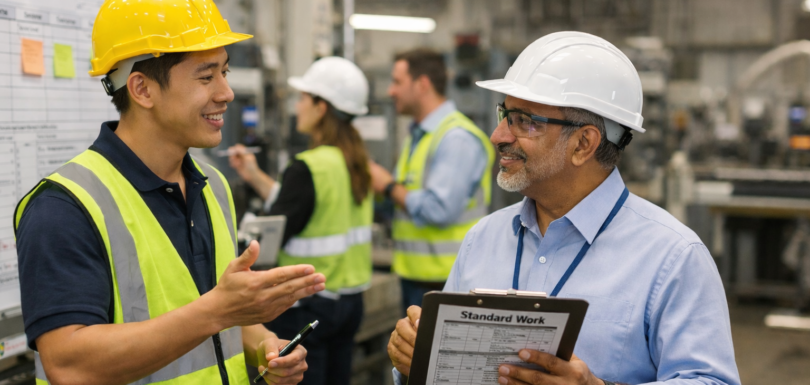
We teach our clients Standard Work every day. And every day, we also teach them why Standard Work alone will never be enough. This sounds like a contradiction. It is. And it is the most important contradiction in Lean. Here at True North Lean, we have worked with businesses across Southeast Asia, from manufacturing floors to service operations that are trying to make sense of what continuous improvement actually means in their context. And the single biggest tension we see inside every organisation we walk into is this one: The harder a team works to standardize, the more they risk stopping people from thinking. Let that sit for a moment. Standard Work is not optional. Toyota said it best: “Without standard work, there is no improvement.” You cannot improve what you cannot measure. You cannot scale what is never written down. When we do a Kaizen event with a team, one of the first things we do is document exactly how the work is being done today, not how people think it is being done, but how it is actually happening on the ground. That baseline is everything. It gives the team a shared language, a reference point, and the ability to see deviations the moment they happen. But here is what nobody tells you when they hand you that SOP binder. The standard is not the destination. It is the starting line for the next improvement. We have walked into organisations where Standard Work documents are printed, laminated, and mounted on walls. Beautiful documents. Untouched for two years. And when we ask the team “what would you change about this process?” the answer is silence. Not because they have no ideas. But because somewhere along the way, the message became “this is how we do it here.” Full stop. That is not Lean. That is compliance dressed up as improvement. True North, as a concept, exists precisely because of this tension. It is the direction you are always moving toward, not a fixed point you ever fully reach. It is the ideal state where every step in your process adds value, where your people are fully empowered to solve problems, where waste is so visible it cannot hide. True North is the compass, not the destination. And a compass only works when you are still moving. At True North Lean, our founder Vijay Allaham has consistently made one thing clear to every client we work with: the organisations that win with Lean are not the ones with the most polished procedures. They are the ones that build a culture where a frontline worker feels completely confident walking up to their supervisor and saying “I found a better way.” And where the supervisor’s first response is “show me” not “that is not in the SOP.” That shift in culture is harder than any process improvement project you will ever run. It takes real respect for people. It takes leadership that models curiosity over control. And it takes a team that understands the standard is a foundation they are empowered to challenge, not a ceiling they are expected to live under. So here is the honest question we want to ask your leadership team today: When was the last time someone on your frontline changed a standard? And when it happened, did they feel celebrated or did they feel like they had broken a rule? Because the answer tells you more about your Lean culture than any audit, any KPI dashboard, or any number of Kaizen events ever will. This is the paradox we live inside every day. Not to resolve it. But to use it. Drop your honest answer in the comments. We want to hear where your organization stands on this right now.
Continue Reading

The New Face of Kaizen and Lean: Trending Techniques Reshaping the Future of Work

Kaizen, the Japanese philosophy of continuous improvement, has been quietly transforming workplaces for decades. But in 2026, it looks nothing like it did ten years ago. Driven by artificial intelligence, connected factories, and a growing pressure to do more with less, Kaizen and Lean methodologies have undergone a quiet revolution. The core idea remains unchanged: eliminate waste, improve constantly, and respect the people doing the work. But the tools? They have changed everything. The Classic Foundation Still Holds Before diving into what is new, it is worth remembering why Kaizen and Lean have lasted this long. Lean thinking strips away every process step that does not directly add value for the customer. Kaizen takes that further. It says improvement is never finished; there is always something small that can be done better today than yesterday. Together, these two philosophies have helped manufacturers, hospitals, banks, and logistics companies save billions of dollars in wasted time, effort, and resources. Their staying power does not come from technology. It comes from culture. A team that genuinely believes small, daily improvements matter will outperform a team that only waits for the next big digital investment. That truth is more relevant now than ever. Digital Kaizen: The Biggest Shift of the Decade Perhaps the most significant evolution in recent years is what practitioners are calling Digital Kaizen, the blending of traditional continuous improvement thinking with the technologies of Industry 4.0. Picture IoT sensors mounted on a production line feeding live data into an AI-powered dashboard, instantly flagging inefficiencies that a human observer might only notice after weeks of watching. That is what replaces the old clipboard-and-stopwatch approach. The impact has been measurable. By 2025, roughly 70% of manufacturers had adopted IoT-based monitoring systems, and AI-driven quality control reduced defect rates by up to 30% in early adopters. A traditional Kaizen event might take a full week to diagnose a single problem. Digital Kaizen can surface the same insight in minutes. That is not just faster, it fundamentally changes how improvement happens. AI and Predictive Maintenance: Lean Gets Smarter One of the most practical modern applications of Lean thinking is predictive maintenance powered by AI and industrial IoT sensors. For decades, factories operated reactively, machines broke, work stopped, engineers scrambled. Lean pushed companies toward preventive schedules. Now, AI goes one step further by predicting failure before it happens. One real-world example says it all: an automotive parts supplier used an AI system that detected a motor bearing degradation pattern a full 14 days before failure. The team replaced it during a planned shift change, avoiding 48 hours of unplanned downtime and saving an estimated $120,000 in lost production. Across the industry, predictive maintenance programs have been shown to cut downtime by up to 50% and reduce maintenance costs by 40%. For any lean practitioner, that kind of preventable waste disappearing from the equation is as good as it gets. Lean 4.0: The Smart Factory Revolution Lean 4.0 is the convergence of proven lean principles with modern digital infrastructure, cloud platforms, digital twins, smart sensors, and real-time analytics working together. Where a traditional manufacturer relied on manual value stream maps drawn on paper, a Lean 4.0 operation simulates the entire production flow digitally before making a single physical change. Where defect tracking was once reactive, AI now flags anomalies the moment they appear. Smart factories built on this foundation have reported up to 50% reductions in unplanned downtime. It is worth being clear: Lean 4.0 is not a replacement for classic lean thinking. It is an amplifier. The discipline of identifying waste, standardising processes, and empowering workers remains exactly the same. What changes is the quality of information people are working with. The Agile-Lean Hybrid: When Speed Matters As Much As Efficiency Manufacturing is not the only world being reshaped. In software development, healthcare, financial services, and logistics, a powerful hybrid approach is gaining serious ground, one that combines Lean’s waste-elimination discipline with Agile’s sprint-based flexibility. Traditional lean was occasionally criticised for being too focused on process stability in environments that change faster than any standard can keep up with. The Agile-Lean hybrid addresses this directly. Teams run short improvement sprints, gather rapid feedback from real outcomes, and adjust quickly, while never losing sight of the fundamental lean goal of cutting waste and delivering value. It is a model that is both rigorous and nimble, which is exactly what the current business environment demands. Supply Chain Kaizen: Improvement Beyond the Factory Gate Modern lean no longer stops at the factory wall. Supply Chain Kaizen takes continuous improvement and extends it across the entire value network, from the raw material supplier at one end to the customer’s doorstep at the other. Organisations are now sharing real-time performance data with their suppliers, setting joint improvement targets, and treating external partners as genuine members of the Kaizen loop rather than vendors to be managed from a distance. This shift matters enormously after several years of global supply chain disruption. Resilience has moved from a talking point to a strategic necessity. Companies that apply lean thinking across their whole supply chain, not just their own operations, are the ones building the kind of flexibility that weathers volatility. Digital Kaizen for SMEs: The Playing Field Levels Out For years, small and medium-sized enterprises (SMEs) watched the digital transformation wave from the sidelines. The tools cost too much, required too much technical expertise, or simply were not designed with smaller businesses in mind. That barrier is now genuinely breaking down. In 2025, the Asian Productivity Organization (APO) launched a dedicated training programme on Digital Kaizen specifically for SMEs, recognising that affordable cloud tools, mobile analytics platforms, and accessible AI have finally brought data-driven continuous improvement within reach of businesses that cannot afford a full digital transformation budget. This democratisation is arguably one of the most important shifts in the Kaizen world right now. Continuous improvement has never belonged only to large corporations, and the tools are finally catching up to that reality.
Continue Reading

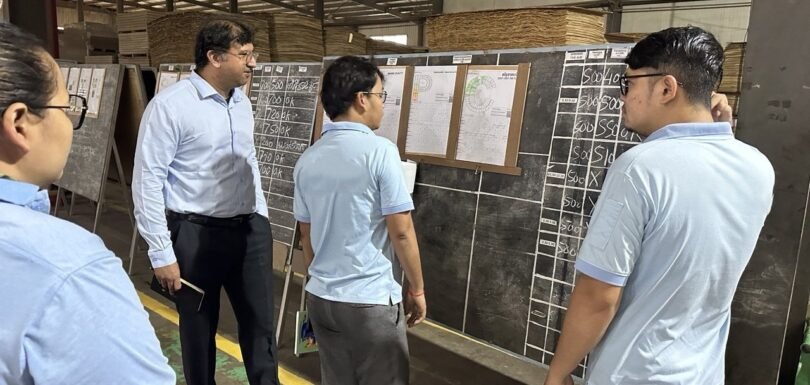
On the Factory Floor, a Simple Board Is Changing How Managers Lead

Walk into almost any well-run factory today and you’ll likely find it somewhere near the production line,  a board covered in numbers, colored magnets, and hand-written notes that, at first glance, looks almost unremarkable. Look closer, though, and you’ll see the nerve center of the entire operation. Shop Floor Management boards, built around a framework known as SQCDP, have quietly become one of the most practical tools in modern manufacturing. They track five things that every plant manager loses sleep over: Safety, Quality, Cost, Delivery, and People. Strip away the jargon and what you have is a daily snapshot of whether a factory is healthy or quietly heading toward trouble. A Morning Ritual That Actually Works Every morning, usually before the main shift gets into full swing, teams gather in front of the board for what’s called a daily huddle. It lasts maybe 15 minutes. Nobody sits down. The agenda runs itself. Was anyone hurt yesterday? Are defect rates creeping up? Did the line hit its output target, or did it fall short, and if so, why? These aren’t comfortable questions, but the board forces them into the open before small problems have a chance to grow into expensive ones. “The whole point is to stop managing by inbox,” one operations director at a consumer goods plant explained. “By the time an issue shows up in a report, it’s already three days old. The board keeps you in the present.” That sense of immediacy is what separates a well-run huddle from a routine status meeting. Managers aren’t there to hear numbers read aloud, they’re there to ask what’s blocking the team and what support they can offer before the day gets away from them. What the Board Actually Tracks The Safety section usually sits at the top, and rightly so. Incident-free days, near-miss reports, and protocol reminders are displayed where everyone can see them. In an era of tightening workplace regulations, having that data visible, rather than buried in a compliance folder, sends a clear signal about what the organization values. Quality metrics sit alongside safety: defect rates, customer complaints, and First Time Quality scores that tell supervisors in a single figure whether products are being built right the first time. Cost and productivity data follows, with Overall Equipment Effectiveness, a measure of how efficiently a machine is actually running versus how efficiently it could be running, often the most scrutinized number on the board. Delivery tracking shows whether the team is hitting its commitments. And the People section, sometimes overlooked, captures attendance, training progress, and employee suggestions, a quiet acknowledgment that the humans running the machines matter just as much as the machines themselves. Turning Data Into Action Numbers on a board mean nothing if nobody does anything about them. That’s why the most effective SFM boards dedicate real space to action planning, using a simple cycle, Plan, Do, Check, Act, to track who is fixing a problem and when they’ve committed to having it resolved. There’s also a defined escalation path for problems too big for a team to solve on its own. Rather than letting an issue stall or quietly disappear, the board provides a structured route upward to management, making it harder for problems to fall through the cracks between shifts or departments. Paper, Pen, or Pixels Not every factory has gone digital, and not every factory needs to. A whiteboard and a set of markers can still do the job effectively, and for smaller operations, the low cost and simplicity are hard to argue with. The tradeoff is effort, someone has to update the numbers manually every day, and comparing trends across multiple sites becomes genuinely difficult. Digital dashboards solve those problems by pulling data directly from production systems, updating in real time, and giving plant managers visibility whether they’re standing on the floor or sitting in a meeting on the other side of the world. As hardware costs fall, more manufacturers are making the switch. But whether analog or digital, the board is only as good as the culture around it. The technology is almost beside the point. What matters is whether people actually show up, ask hard questions, and leave with a plan.
Continue Reading

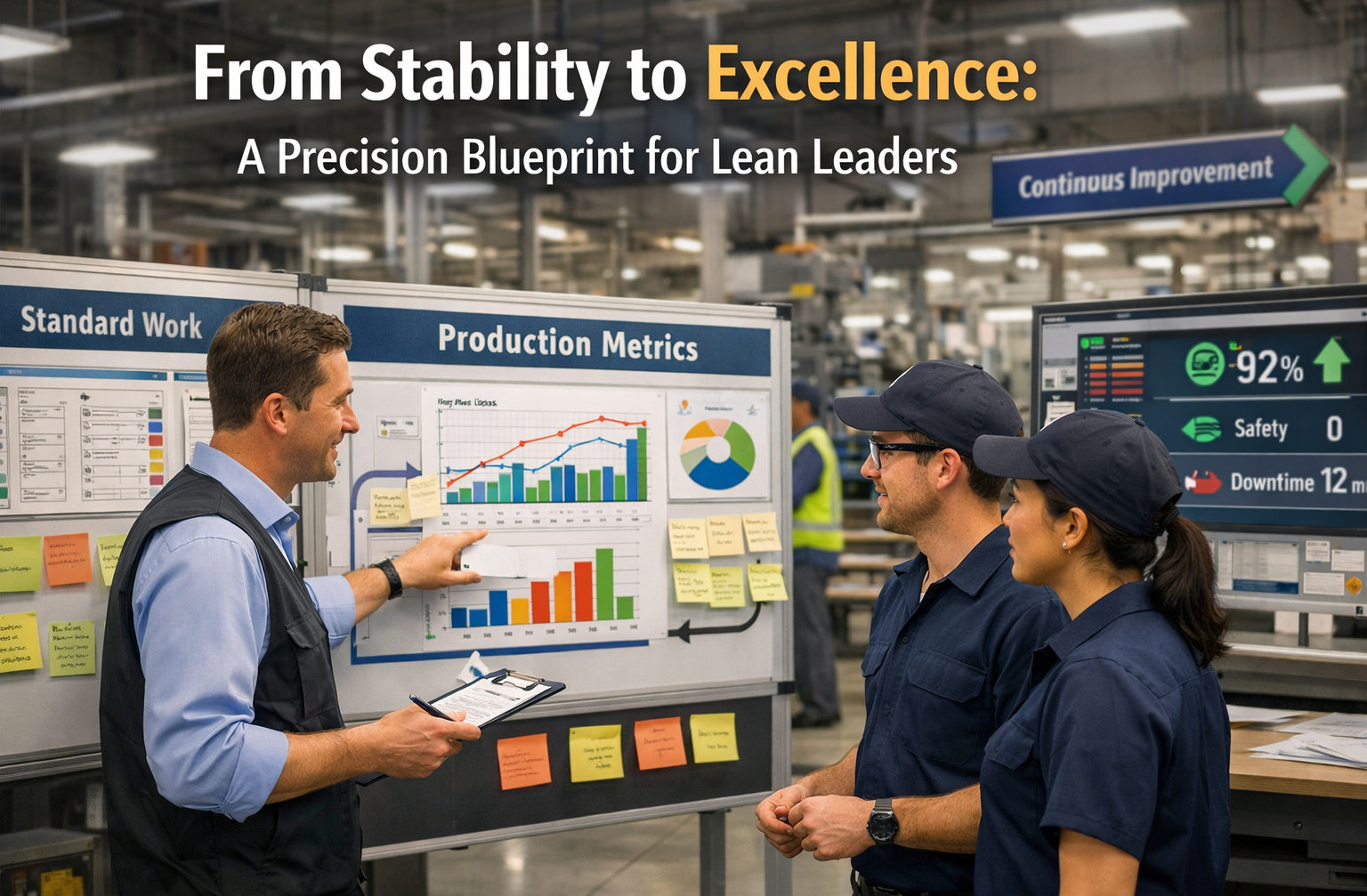
From Stability to Excellence: A Precision Blueprint for Lean Leaders

Most Lean transformations fail not in the conference room but on the shop floor, not because the strategy was wrong but because the discipline to execute it consistently was absent. Sustainable manufacturing excellence is not a destination reached through sporadic improvement events or technology investments alone. It demands something far more rigorous: daily process control, unyielding operational discipline, and relentless continuous improvement woven into the fabric of every shift, every line, every decision. The Architecture Beneath Excellence Before any organization can talk about optimization, it must be honest about its foundation. The Architecture of Excellence is built in three ascending layers: a base of Standardization, a core of Process Control and Deviation Management, and an apex of Optimization and Continuous Improvement. What drives the structure upward is not ambition, it is the PDCA loop functioning as a continuous kinetic engine, cycling learning into action and action into elevated standards. This architecture matters because excellence is not a static peak. It is an expanding loop. Organizations that attempt to leapfrog the base and land at the apex, deploying Industry 4.0 machines without first maturing their methods and manpower, do not accelerate excellence; they create expensive bottlenecks. The sequence is non-negotiable. The Three Pillars That Carry the Weight Baseline Standardization is where operational integrity begins. Standard Work Routines define the exact sequence and timing of activities, visual controls make the standard visible and anomalies immediately detectable, and the Manufacturing Operations Manual serves as the immutable playbook for execution. Without a predictable baseline, organizations cannot measure accurately, cannot improve reliably, and cannot prevent operational backsliding. The second pillar, deviation management, is where most organizations expose their true operational posture. System degradation is inevitable when deviations are tolerated rather than eradicated. A robust deviation cycle moves rapidly through three stages: Detect anomalies in real time through visual controls, Contain the fracture immediately through layered audits to protect throughput, and Eradicate the root cause permanently through structured problem-solving. The difference between a capable operation and a firefighting operation lives entirely in how quickly and decisively this cycle runs. Continuous Optimization is the third pillar and it is only credible when built on the first two. Value Stream Mapping eliminates cross-functional flow disruptions. Jishuken workshops unleash self-directed, immediate-action waste elimination from the workforce. Predictive analytics transition the organization from reactive response to algorithmic prevention. Optimization without stability is noise. Optimization on a stable foundation is competitive leverage. Diagnosing Where You Stand The Operational Posture Matrix is a frank diagnostic for leaders willing to be honest about their current state. Organizations in Reactive Management mode rely on tribal knowledge, fight fires at the point of defect, and manage through top-down directives. Those in Process Control mode have real-time dashboards, execute Standard Work, and produce stable, predictable throughput. Manufacturing Excellence organizations operate with predictive analytics, high-engagement Kaizen culture, and margin-expanding output. Most manufacturing organizations, if honest, sit between the first and second columns, capable of more, yet anchored by undisciplined execution. The Pipeline and the System The 8-Step Excellence Pipeline codifies the maturity sequence: Strategy alignment, Standards implementation, Stability, Capability, Control, Waste Reduction, Flow Optimization, and finally, Continuous Excellence. Attempting to optimize flow at Step 7 without first securing stability at Step 3 guarantees systemic failure, a principle violated in nearly every rushed transformation. Equally important is the 4Ms+E System Radar, which recognizes that isolated upgrades generate zero systemic return. Manpower, Machine, Method, Material, and Environment are interlocking nodes. Improving one while neglecting others creates imbalance, not progress. True manufacturing excellence emerges only when all five dimensions advance in concert. Excellence Is a Financial Imperative Shop floor management is not a cost center, it is a margin-protection engine. Disciplined standardization and deviation management directly drive OEE by expanding capacity utilization without capital expenditure. Root-cause eradication slashes the Cost of Poor Quality, stopping profit leakage at the source. Value stream design converts static work-in-progress into realized cash flow through accelerated inventory turns and throughput yield. The final truth that every Lean leader must internalize is this: strategy without execution discipline is organizational theater. The organizations that win in manufacturing are not those with the most sophisticated tools, they are the ones with leaders disciplined enough to hold the standard on Tuesday morning when no one is watching and humble enough to ask why the process deviated before asking who failed. Execution is the ultimate strategy. Source: Fundamentals of daily shop floor management by Philip J. Gisi
Continue Reading

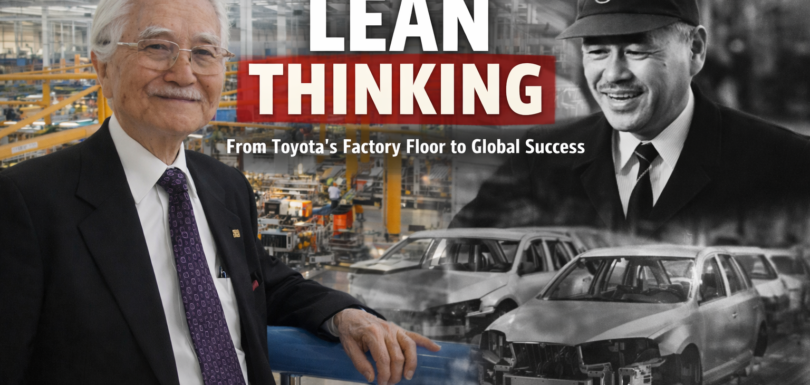
Lean Thinking Is Built on Discipline, Not Fashion

Why the pioneers of Lean continue to influence how serious organisations compete Management history is full of movements that arrive with energy and fade with equal speed. Lean, however, has endured for more than seven decades. Its longevity is not accidental. It survives because it addresses something fundamental: how work flows, how problems are solved, and how leaders behave under pressure. Lean did not begin as a corporate initiative. It began as a response to constraint. In post-war Japan, resources were scarce and survival demanded ingenuity. Within that context, Taiichi Ohno began challenging assumptions embedded in traditional mass production. Large batches and heavy inventory, he observed, created the illusion of productivity while hiding inefficiencies. If materials were piling up between processes, something was wrong. If defects were discovered late, something had been ignored earlier. Ohno’s contribution was not merely technical. He reframed efficiency as the steady removal of waste. Producing only what was needed, when it was needed, and in the quantity required was not a slogan; it was a discipline. Flow mattered. Interruptions revealed weaknesses. Waiting time exposed imbalance. Alongside him, Shigeo Shingo sharpened the system’s technical edge. He focused on reducing setup times that had long been considered unavoidable. Through systematic experimentation, he proved that hours-long changeovers could be reduced dramatically. His work on mistake-proofing reinforced a central Lean principle: quality should be built into the process, not inspected at the end. If errors recur, the system is speaking. Leaders must listen. The institutional backing of Eiji Toyoda ensured that these ideas became cultural norms rather than isolated improvements. Lean was not allowed to remain a collection of experiments; it became the operating backbone of Toyota. The philosophical roots, however, stretch even further back. Sakichi Toyoda introduced the concept of Jidoka, the idea that machines should stop automatically when abnormalities occur. This simple principle embedded responsibility into the production system. His son, Kiichiro Toyoda, reinforced the conviction that production must align closely with real customer demand. The wider world came to understand this system through the research of James P. Womack and Daniel T. Jones, who described Toyota’s approach as “Lean” in 1990. Their work highlighted that what differentiated high-performing organisations was not scale alone, but a relentless focus on value and flow. Over time, Lean travelled beyond automotive manufacturing. Hospitals applied its methods to reduce patient waiting times. Banks used it to streamline transaction processing. Logistics firms used it to stabilise supply chains. Yet as Lean spread, misinterpretation followed. In some organisations, it became synonymous with cost reduction or short-term productivity drives. Visual boards appeared. Workshops were conducted. Terminology was adopted. But without consistent leadership behaviour and daily problem-solving routines, improvements proved fragile. The pioneers of Lean never presented it as a quick fix. They emphasised observation at the workplace, structured experimentation, and respect for frontline knowledge. Lean requires leaders to ask questions rather than issue instructions. It requires teams to confront problems openly rather than conceal them behind excess inventory or overtime. In the current era of digital transformation, Lean’s relevance has arguably increased. Automation can accelerate throughput, but it cannot correct instability in upstream processes. Data analytics can reveal patterns, but they cannot replace disciplined thinking on the ground. When technology is layered onto weak systems, inefficiency merely moves faster. Lean’s endurance lies in its simplicity. It insists that organisations stabilise before they scale. It encourages clarity before complexity. It demands that improvement be continuous, not episodic. For companies seeking resilience amid volatility, the lesson remains clear. Lean is not a toolkit to deploy during difficult quarters. It is a long-term commitment to designing systems that expose problems early, empower people to solve them, and align effort with genuine customer value. The pioneers who shaped Lean were not chasing recognition. They were solving practical problems under real constraints. That practicality explains why, decades later, their thinking continues to guide organisations determined to compete with discipline rather than noise.
Continue Reading

Categories

  • No categories

Latest Posts

Subscribe Newsletter

Sign up to receive notifications about the latest news and events from us!

    x

    Inspiring Your Team to Continuous Growth and Sustainable Excellence.

    Address Business
    11 Bakheng Street, Svay Dangkum,
    Siem Reap, Cambodia
    Contact With Us
    +855 10 983138
    info@truenorthlean.com
    Select the fields to be shown. Others will be hidden. Drag and drop to rearrange the order.
    • Image
    • SKU
    • Rating
    • Price
    • Stock
    • Availability
    • Add to cart
    • Description
    • Content
    • Weight
    • Dimensions
    • Additional information
    Click outside to hide the comparison bar
    Compare