11 Bakheng Street, Svay Dangkum,
Siem Reap, Cambodia
Email our experts:
info@truenorthlean.com
11 Bakheng Street, Svay Dangkum,
Siem Reap, Cambodia
Email our experts:
info@truenorthlean.com

Blog

The Fishbone That Changed Everything

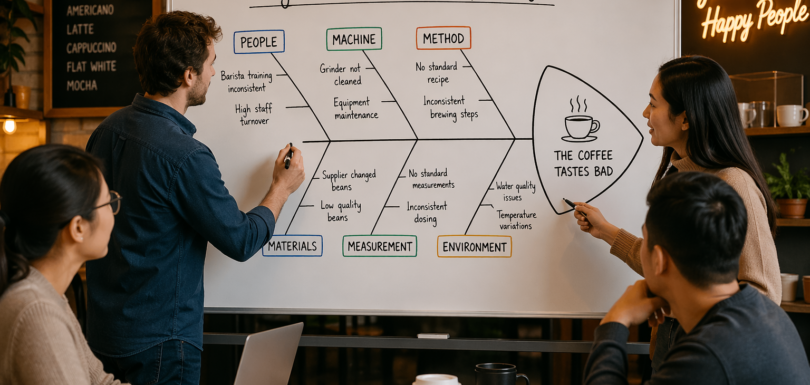
A human story behind the Ishikawa diagram Have you ever sat in a meeting where something went wrong and everyone started pointing fingers? The machine broke, the supplier was late, the new guy made a mistake, and suddenly no one agrees on anything. An hour later, you still have no real answer. Just a room full of frustrated people and a problem that still needs fixing. That feeling, that messy, circular blame game is exactly what Kaoru Ishikawa was trying to kill when he sat down and drew what the world would later call the fishbone diagram. Japan, 1943. A Country Trying to Rebuild. To understand why this diagram matters so much, you have to picture Japan in the early 1940s. The country’s factories were under tremendous pressure. Quality was inconsistent. Products were failing. And nobody really had a clear, structured way of figuring out why things kept going wrong. Kaoru Ishikawa was a chemical engineer working with a team at Kawasaki Steel Works. He noticed that whenever a defect showed up, people would chase symptoms instead of causes. They’d fix one thing, and the problem would come back through a different door. It was exhausting and wasteful. So in 1943, he did something simple but brilliant. He drew a diagram, a spine with branches coming off it, where every possible cause of a problem could be written down and grouped by category. It looked like the skeleton of a fish. And it worked. For the first time, teams could look at a problem together, from the same angle, without the conversation going in circles. The Man Who Believed Workers Had the Answers Dr. Kaoru Ishikawa was born in 1915 in Tokyo and spent most of his career at the University of Tokyo. He was deeply influenced by the quality movement happening around him, especially the ideas coming from American statistician W. Edwards Deming, but he took things in his own direction. What made Ishikawa different was that he genuinely believed ordinary workers, not just managers or engineers, could solve the problems around them if they were given the right tools and the right environment. He wasn’t interested in top-down quality control. He wanted it to be everyone’s job. He published the diagram formally in his 1968 book, Guide to Quality Control, and from there it spread first through Japanese industry, then to the rest of the world. He passed away in 1989, but the fishbone diagram he drew in a steel factory in 1943 is still being used in hospitals, tech companies, and classrooms every single day. So How Does It Actually Work? You start by writing the problem, the effect, on the right side of a page, like the head of a fish. Then you draw a horizontal line running left from it. That is your spine. Off that spine, you draw diagonal branches. Each branch represents a category of possible causes. In manufacturing, people often use the 6Ms: Man, Machine, Method, Material, Measurement, and Environment. In services or healthcare, the categories might look a little different, but the idea is the same: you are grouping causes so nothing gets missed and nothing gets confused with something else. From each of those branches, you keep asking “why?” and adding smaller branches for more specific causes. By the time you’re done, you have a complete pictur, not just one opinion, but every possible angle laid out in front of the whole team. A Real Example: Why Is the Coffee Always Wrong? Say you run a small café and customers keep sending back their coffee. The problem seems obvious, the coffee tastes bad. But is it really that simple? You sit down and draw the fishbone. Under People, you notice your barista was trained differently from the rest of the team. Under Machine, you discover the coffee grinder hasn’t been cleaned in two weeks. Under Method, there is no standard recipe, everyone is guessing the measurements. Under Materials, you find out the supplier quietly switched to a different bean last month without telling anyone. Suddenly, “the coffee tastes bad” becomes four separate, fixable problems. You retrain the team, clean the grinder, write down a standard recipe, and call the supplier. Within a week, the complaints stop. That is what the Ishikawa diagram does. It does not give you answers; it gives you the right questions. And sometimes, that is all you need. Still Relevant, All These Years Later There is something refreshing about a tool that has survived eight decades without needing an update. The Ishikawa diagram is still one of the seven basic tools of quality control recognised by ISO, and it is taught in business schools, engineering programmes, and healthcare training around the world. In a world obsessed with speed and technology, it is a quiet but powerful reminder that the best way to fix a problem is to truly understand it first. Slow down, draw the fish, and the solution usually finds you.
Continue Reading

Standard Work Is Killing Your Improvement Culture. Here’s Why We Still Teach It. 

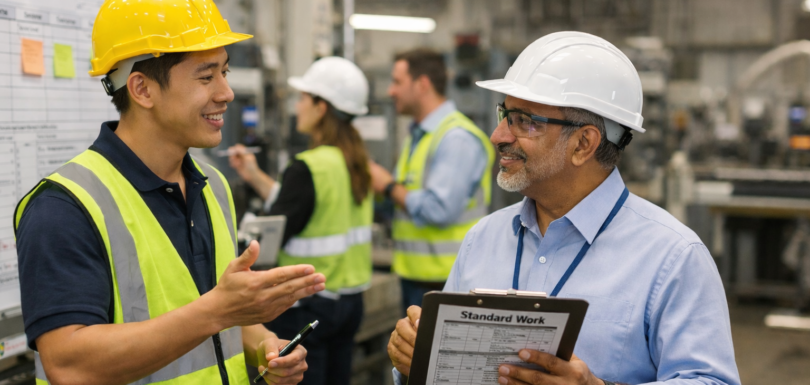
We teach our clients Standard Work every day. And every day, we also teach them why Standard Work alone will never be enough. This sounds like a contradiction. It is. And it is the most important contradiction in Lean. Here at True North Lean, we have worked with businesses across Southeast Asia, from manufacturing floors to service operations that are trying to make sense of what continuous improvement actually means in their context. And the single biggest tension we see inside every organisation we walk into is this one: The harder a team works to standardize, the more they risk stopping people from thinking. Let that sit for a moment. Standard Work is not optional. Toyota said it best: “Without standard work, there is no improvement.” You cannot improve what you cannot measure. You cannot scale what is never written down. When we do a Kaizen event with a team, one of the first things we do is document exactly how the work is being done today, not how people think it is being done, but how it is actually happening on the ground. That baseline is everything. It gives the team a shared language, a reference point, and the ability to see deviations the moment they happen. But here is what nobody tells you when they hand you that SOP binder. The standard is not the destination. It is the starting line for the next improvement. We have walked into organisations where Standard Work documents are printed, laminated, and mounted on walls. Beautiful documents. Untouched for two years. And when we ask the team “what would you change about this process?” the answer is silence. Not because they have no ideas. But because somewhere along the way, the message became “this is how we do it here.” Full stop. That is not Lean. That is compliance dressed up as improvement. True North, as a concept, exists precisely because of this tension. It is the direction you are always moving toward, not a fixed point you ever fully reach. It is the ideal state where every step in your process adds value, where your people are fully empowered to solve problems, where waste is so visible it cannot hide. True North is the compass, not the destination. And a compass only works when you are still moving. At True North Lean, our founder Vijay Allaham has consistently made one thing clear to every client we work with: the organisations that win with Lean are not the ones with the most polished procedures. They are the ones that build a culture where a frontline worker feels completely confident walking up to their supervisor and saying “I found a better way.” And where the supervisor’s first response is “show me” not “that is not in the SOP.” That shift in culture is harder than any process improvement project you will ever run. It takes real respect for people. It takes leadership that models curiosity over control. And it takes a team that understands the standard is a foundation they are empowered to challenge, not a ceiling they are expected to live under. So here is the honest question we want to ask your leadership team today: When was the last time someone on your frontline changed a standard? And when it happened, did they feel celebrated or did they feel like they had broken a rule? Because the answer tells you more about your Lean culture than any audit, any KPI dashboard, or any number of Kaizen events ever will. This is the paradox we live inside every day. Not to resolve it. But to use it. Drop your honest answer in the comments. We want to hear where your organization stands on this right now.
Continue Reading

The New Face of Kaizen and Lean: Trending Techniques Reshaping the Future of Work

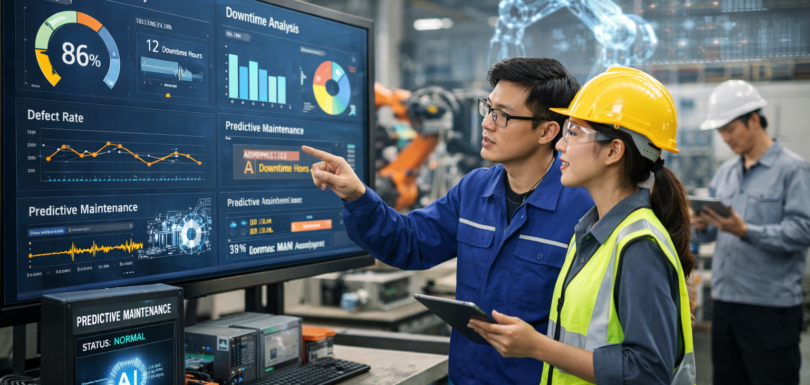
Kaizen, the Japanese philosophy of continuous improvement, has been quietly transforming workplaces for decades. But in 2026, it looks nothing like it did ten years ago. Driven by artificial intelligence, connected factories, and a growing pressure to do more with less, Kaizen and Lean methodologies have undergone a quiet revolution. The core idea remains unchanged: eliminate waste, improve constantly, and respect the people doing the work. But the tools? They have changed everything. The Classic Foundation Still Holds Before diving into what is new, it is worth remembering why Kaizen and Lean have lasted this long. Lean thinking strips away every process step that does not directly add value for the customer. Kaizen takes that further. It says improvement is never finished; there is always something small that can be done better today than yesterday. Together, these two philosophies have helped manufacturers, hospitals, banks, and logistics companies save billions of dollars in wasted time, effort, and resources. Their staying power does not come from technology. It comes from culture. A team that genuinely believes small, daily improvements matter will outperform a team that only waits for the next big digital investment. That truth is more relevant now than ever. Digital Kaizen: The Biggest Shift of the Decade Perhaps the most significant evolution in recent years is what practitioners are calling Digital Kaizen, the blending of traditional continuous improvement thinking with the technologies of Industry 4.0. Picture IoT sensors mounted on a production line feeding live data into an AI-powered dashboard, instantly flagging inefficiencies that a human observer might only notice after weeks of watching. That is what replaces the old clipboard-and-stopwatch approach. The impact has been measurable. By 2025, roughly 70% of manufacturers had adopted IoT-based monitoring systems, and AI-driven quality control reduced defect rates by up to 30% in early adopters. A traditional Kaizen event might take a full week to diagnose a single problem. Digital Kaizen can surface the same insight in minutes. That is not just faster, it fundamentally changes how improvement happens. AI and Predictive Maintenance: Lean Gets Smarter One of the most practical modern applications of Lean thinking is predictive maintenance powered by AI and industrial IoT sensors. For decades, factories operated reactively, machines broke, work stopped, engineers scrambled. Lean pushed companies toward preventive schedules. Now, AI goes one step further by predicting failure before it happens. One real-world example says it all: an automotive parts supplier used an AI system that detected a motor bearing degradation pattern a full 14 days before failure. The team replaced it during a planned shift change, avoiding 48 hours of unplanned downtime and saving an estimated $120,000 in lost production. Across the industry, predictive maintenance programs have been shown to cut downtime by up to 50% and reduce maintenance costs by 40%. For any lean practitioner, that kind of preventable waste disappearing from the equation is as good as it gets. Lean 4.0: The Smart Factory Revolution Lean 4.0 is the convergence of proven lean principles with modern digital infrastructure, cloud platforms, digital twins, smart sensors, and real-time analytics working together. Where a traditional manufacturer relied on manual value stream maps drawn on paper, a Lean 4.0 operation simulates the entire production flow digitally before making a single physical change. Where defect tracking was once reactive, AI now flags anomalies the moment they appear. Smart factories built on this foundation have reported up to 50% reductions in unplanned downtime. It is worth being clear: Lean 4.0 is not a replacement for classic lean thinking. It is an amplifier. The discipline of identifying waste, standardising processes, and empowering workers remains exactly the same. What changes is the quality of information people are working with. The Agile-Lean Hybrid: When Speed Matters As Much As Efficiency Manufacturing is not the only world being reshaped. In software development, healthcare, financial services, and logistics, a powerful hybrid approach is gaining serious ground, one that combines Lean’s waste-elimination discipline with Agile’s sprint-based flexibility. Traditional lean was occasionally criticised for being too focused on process stability in environments that change faster than any standard can keep up with. The Agile-Lean hybrid addresses this directly. Teams run short improvement sprints, gather rapid feedback from real outcomes, and adjust quickly, while never losing sight of the fundamental lean goal of cutting waste and delivering value. It is a model that is both rigorous and nimble, which is exactly what the current business environment demands. Supply Chain Kaizen: Improvement Beyond the Factory Gate Modern lean no longer stops at the factory wall. Supply Chain Kaizen takes continuous improvement and extends it across the entire value network, from the raw material supplier at one end to the customer’s doorstep at the other. Organisations are now sharing real-time performance data with their suppliers, setting joint improvement targets, and treating external partners as genuine members of the Kaizen loop rather than vendors to be managed from a distance. This shift matters enormously after several years of global supply chain disruption. Resilience has moved from a talking point to a strategic necessity. Companies that apply lean thinking across their whole supply chain, not just their own operations, are the ones building the kind of flexibility that weathers volatility. Digital Kaizen for SMEs: The Playing Field Levels Out For years, small and medium-sized enterprises (SMEs) watched the digital transformation wave from the sidelines. The tools cost too much, required too much technical expertise, or simply were not designed with smaller businesses in mind. That barrier is now genuinely breaking down. In 2025, the Asian Productivity Organization (APO) launched a dedicated training programme on Digital Kaizen specifically for SMEs, recognising that affordable cloud tools, mobile analytics platforms, and accessible AI have finally brought data-driven continuous improvement within reach of businesses that cannot afford a full digital transformation budget. This democratisation is arguably one of the most important shifts in the Kaizen world right now. Continuous improvement has never belonged only to large corporations, and the tools are finally catching up to that reality.
Continue Reading

On the Factory Floor, a Simple Board Is Changing How Managers Lead

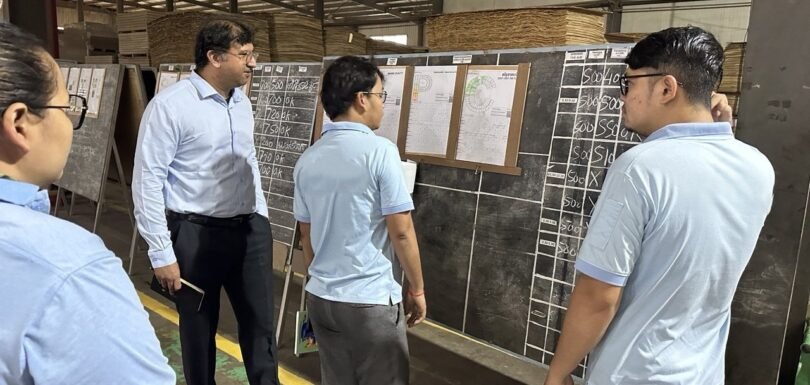
Walk into almost any well-run factory today and you’ll likely find it somewhere near the production line,  a board covered in numbers, colored magnets, and hand-written notes that, at first glance, looks almost unremarkable. Look closer, though, and you’ll see the nerve center of the entire operation. Shop Floor Management boards, built around a framework known as SQCDP, have quietly become one of the most practical tools in modern manufacturing. They track five things that every plant manager loses sleep over: Safety, Quality, Cost, Delivery, and People. Strip away the jargon and what you have is a daily snapshot of whether a factory is healthy or quietly heading toward trouble. A Morning Ritual That Actually Works Every morning, usually before the main shift gets into full swing, teams gather in front of the board for what’s called a daily huddle. It lasts maybe 15 minutes. Nobody sits down. The agenda runs itself. Was anyone hurt yesterday? Are defect rates creeping up? Did the line hit its output target, or did it fall short, and if so, why? These aren’t comfortable questions, but the board forces them into the open before small problems have a chance to grow into expensive ones. “The whole point is to stop managing by inbox,” one operations director at a consumer goods plant explained. “By the time an issue shows up in a report, it’s already three days old. The board keeps you in the present.” That sense of immediacy is what separates a well-run huddle from a routine status meeting. Managers aren’t there to hear numbers read aloud, they’re there to ask what’s blocking the team and what support they can offer before the day gets away from them. What the Board Actually Tracks The Safety section usually sits at the top, and rightly so. Incident-free days, near-miss reports, and protocol reminders are displayed where everyone can see them. In an era of tightening workplace regulations, having that data visible, rather than buried in a compliance folder, sends a clear signal about what the organization values. Quality metrics sit alongside safety: defect rates, customer complaints, and First Time Quality scores that tell supervisors in a single figure whether products are being built right the first time. Cost and productivity data follows, with Overall Equipment Effectiveness, a measure of how efficiently a machine is actually running versus how efficiently it could be running, often the most scrutinized number on the board. Delivery tracking shows whether the team is hitting its commitments. And the People section, sometimes overlooked, captures attendance, training progress, and employee suggestions, a quiet acknowledgment that the humans running the machines matter just as much as the machines themselves. Turning Data Into Action Numbers on a board mean nothing if nobody does anything about them. That’s why the most effective SFM boards dedicate real space to action planning, using a simple cycle, Plan, Do, Check, Act, to track who is fixing a problem and when they’ve committed to having it resolved. There’s also a defined escalation path for problems too big for a team to solve on its own. Rather than letting an issue stall or quietly disappear, the board provides a structured route upward to management, making it harder for problems to fall through the cracks between shifts or departments. Paper, Pen, or Pixels Not every factory has gone digital, and not every factory needs to. A whiteboard and a set of markers can still do the job effectively, and for smaller operations, the low cost and simplicity are hard to argue with. The tradeoff is effort, someone has to update the numbers manually every day, and comparing trends across multiple sites becomes genuinely difficult. Digital dashboards solve those problems by pulling data directly from production systems, updating in real time, and giving plant managers visibility whether they’re standing on the floor or sitting in a meeting on the other side of the world. As hardware costs fall, more manufacturers are making the switch. But whether analog or digital, the board is only as good as the culture around it. The technology is almost beside the point. What matters is whether people actually show up, ask hard questions, and leave with a plan.
Continue Reading

Why Sustainability Training Is Becoming Part of Everyday Business

When you sit with business leaders these days, there is a certain mix of curiosity and concern in the room. Everyone can feel that the world around them is shifting. Weather patterns affect supply chains. Energy bills behave unpredictably. Customers want clarity on where products come from and how responsibly companies operate. None of this feels abstract anymore. It shows up quietly in operational costs, planning cycles and even recruitment conversations. This is why more organisations are asking their teams to learn about sustainability in a practical, business focused way. Not as a theory, not as a compliance requirement, but as a skill set they genuinely need. At True North Lean, we see this every week. Teams who once spoke only about efficiency or cost now have questions about carbon footprints, waste streams and long-term resilience. It is a natural evolution in how companies think about their future. To support this, we offer training that helps people make sense of what sustainability actually means in a business environment. Many participants walk in feeling unsure where to begin, and they leave with a clearer view of the landscape. The sessions break down global issues into everyday realities. How resources are used, how waste travels through a system, how people in an organisation make choices without realising the ripple effect those choices create. It is eye opening for many because the concepts are not presented as pressure. They are shown as opportunities to strengthen operations. The learning style is interactive and conversational. People exchange stories from their own workplaces, point out odd habits they never questioned and begin connecting dots. Once they understand the basic pillars of sustainability, it becomes easier to see where their organisation stands and where improvements genuinely make sense. We encourage them to think small at first. A few thoughtful changes in processes often make a noticeable difference. Alongside this foundational training, we also offer another pathway for teams already immersed in Lean. This group tends to pick up sustainability ideas very quickly because Lean thinking already trains the eye to see what others miss. When they look at sustainability through that lens, things start clicking. Waste takes on a broader meaning, covering everything from excess electricity to unnecessary transport or poorly designed workflows that silently drain resources. The beauty of this approach is its practicality. Lean practitioners already know tools like root cause analysis, visual management or value stream mapping. During our training, they learn to adapt these tools to reveal environmental impact alongside operational performance. For example, a simple walk through a facility may uncover machines running longer than needed or materials being handled in ways that raise costs and environmental load simultaneously. These discoveries come from observation, not theory. Culture plays a huge role as well. Sustainability cannot grow if it sits in one department. It becomes part of the company’s rhythm only when everyday conversations begin to shift. Our training emphasises this. Teams learn how to bring sustainability into routine discussions, improvement meetings and decision making processes without making it feel heavy or complicated. Once people start noticing small patterns, they naturally suggest improvements. That is how real change begins. Why is all of this so important now? Because businesses are realising that sustainability is not a trend. It is part of long term risk management, brand trust and operational strength. Markets are changing faster than before, and companies with stronger internal capability will always adapt better. Training gives people the language, the confidence and the perspective they need to participate in that transition. At True North Lean, our role is simple. We help organisations build teams that can think clearly, work responsibly and look ahead rather than react late. Sustainability and Lean complement one another more than most people expect. Both are about noticing what others overlook and creating systems that work well over time. Companies that invest in this learning today are positioning themselves for a more resilient tomorrow. They gain employees who understand the bigger picture, leaders who can guide meaningful change and operations that run with greater awareness. In a world where expectations grow every year, that mindset makes all the difference.
Continue Reading

Rebuilding Strength A Quiet Story of Lean and the People Who Lived It

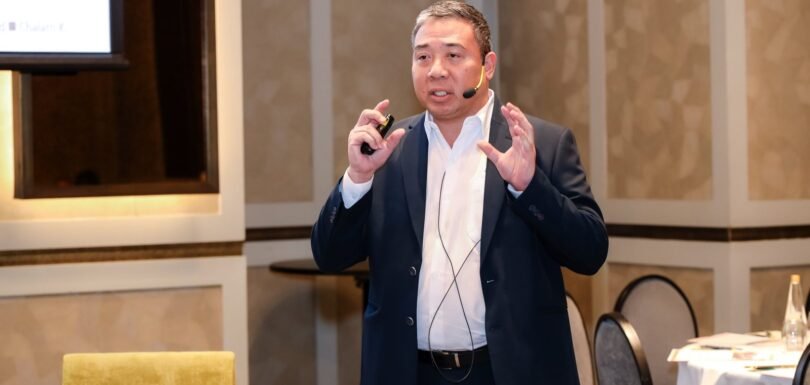
Presented at the True North Lean CXO Summit in Vietnam There are stories that come dressed in numbers and charts. Then there are stories that arrive quietly and stay with people long after the session ends. When Chalath Kongsuwan spoke in Vietnam during the True North Lean CXO Summit, his story felt like that. It did not try to impress anyone with complicated jargon. It felt more like a leader looking back on something his team went through together, a moment that changed the way they understood their work and one another. Chalath leads a large aerospace component facility in Thailand, a place where precision is not optional and delays affect aircraft manufacturers around the world. His experience runs deep, but even years in this industry do not prepare anyone for the shock of a sudden fire. It happened in 2023. One moment the plant was full of movement and rhythm, and the next the entire atmosphere changed. The kind of stillness that follows an unexpected event is something people remember for a long time. The Turning Point After the fire, many expected long downtime. Yet what happened next surprised even those inside the organisation. The team did not sink into uncertainty. They moved. Slowly at first, almost cautiously, and then with more confidence. What could have been a long recovery became one of the quickest the company had ever seen. Chalath described that period with a kind of calm appreciation. He remembered the faces of his team members, how they gathered without being asked, how small groups formed on their own to inspect areas, plan tasks or simply reassure each other. Lean was not a theory in that moment. It was a behaviour that rose naturally. The People Behind the Structure In the months that followed, the organisation created groups to guide the transformation. A committee helped keep the direction steady, but the real spark came from the people inside those groups. They were not chosen for their titles as much as for their willingness to step forward. Some focused on standard work, others on technical issues, others on communication. What mattered was that they supported each other. Something shifted. Teams that usually worked in separate sections began showing up in one another’s areas, asking questions, suggesting ideas and learning small details they never paid attention to before. It felt less like a formal structure and more like a community taking shape. Looking Closely at the Work Before improvement began, everyone spent time looking closely at the entire flow of work. People walked through the plant with a different kind of attention. They stood longer near machines. They watched how materials moved, how waiting built up silently, and how small obstacles grew into bigger delays. What they saw changed the way they felt about improvement. It was no longer something introduced from outside. It became something they wanted to fix because they saw how much potential was being lost. For many employees, this was the first time they truly saw their workplace from edge to edge, not just the area they were responsible for. Small Wins That Built Confidence Once they started improving, progress came from many directions. Some teams found ways to make cutting output smoother. Others worked on machine effectiveness in forging. Quality teams looked at how to reduce rework. Set up teams focused on reducing changeover time. Etching and finishing teams looked for places where small delays added up. None of these improvements looked dramatic on their own. But together they created a rhythm of progress. The atmosphere changed. People who had never spoken much started offering suggestions. Younger staff stepped up. Supervisors stopped sounding like supervisors and more like guides. That was when the transformation really rooted itself. Daily Habits That Held Everything Together What truly moved the culture forward were the habits that formed. The plant started its mornings by gathering around simple boards that showed what was happening that day. Conversations were short and honest. People pointed out what went well, what looked worrying, and what needed someone’s attention. Leaders walked the floor not to check compliance but to understand the work. They asked questions, listened and helped remove obstacles that slowed people down. A cleaning day also took place. It was not just about sweeping or rearranging shelves. It was a moment when everyone stopped thinking of the plant as separate sections and began to see it as one shared space. That day mattered more than many realised. It connected people in a quiet, genuine way. A Thought That Stayed With Every Listener At the summit in Vietnam, one sentence from Chalath stayed with the audience. He said that tools may improve a process, but only a shift in mindset changes an organisation. There was a stillness in the room when he said it. It sounded simple, almost too simple, but it felt true. After all, the story he told was not about perfect implementation. It was about people who decided to move forward even when the situation felt heavy. His message reminded everyone that Lean begins with people who care enough to look honestly at their work and at themselves. A Workplace Renewed by Its Own People Today the plant in Thailand stands stronger than before the fire. The recovery built a deeper kind of unity. People who once saw their roles as separate now see themselves as part of one shared effort. Communication flows easier. Collaboration feels natural. New ideas do not need encouragement to appear. They come on their own. The transformation is not a finished chapter. It continues, evolving with each conversation and each new problem that emerges. And that is perhaps the most powerful sign of all. A Lean journey is never complete. It grows as the people grow. A Story With Lessons Beyond One Plant Many leaders left the summit remembering not the technical details but the emotional truth of Chalath’s account. It showed that resilience grows fastest when people trust each other. It showed
Continue Reading

Categories

  • No categories

Latest Posts

Subscribe Newsletter

Sign up to receive notifications about the latest news and events from us!

    x

    Inspiring Your Team to Continuous Growth and Sustainable Excellence.

    Address Business
    11 Bakheng Street, Svay Dangkum,
    Siem Reap, Cambodia
    Contact With Us
    +855 10 983138
    info@truenorthlean.com
    Select the fields to be shown. Others will be hidden. Drag and drop to rearrange the order.
    • Image
    • SKU
    • Rating
    • Price
    • Stock
    • Availability
    • Add to cart
    • Description
    • Content
    • Weight
    • Dimensions
    • Additional information
    Click outside to hide the comparison bar
    Compare